
Water-Damaged Ceiling Mold Removal in Fort Pierce, FL
A ceiling that gets wet from a roof or plumbing leak can start growing mold within 24 to 48 hours if it does not dry. The fix is to stop the water, keep people out from under any sagging area, document the damage, dry or remove the wet drywall and insulation, and remove any mold in containment before repairing.
Water damage and mold are the same problem at different points in time. The EPA notes that mold is unlikely to grow if wet materials are dried within 24 to 48 hours. After that, the odds go the other way. Fort Pierce's heat and humidity speed it up, and hurricane season, June 1 to November 30, is when roofs get tested.
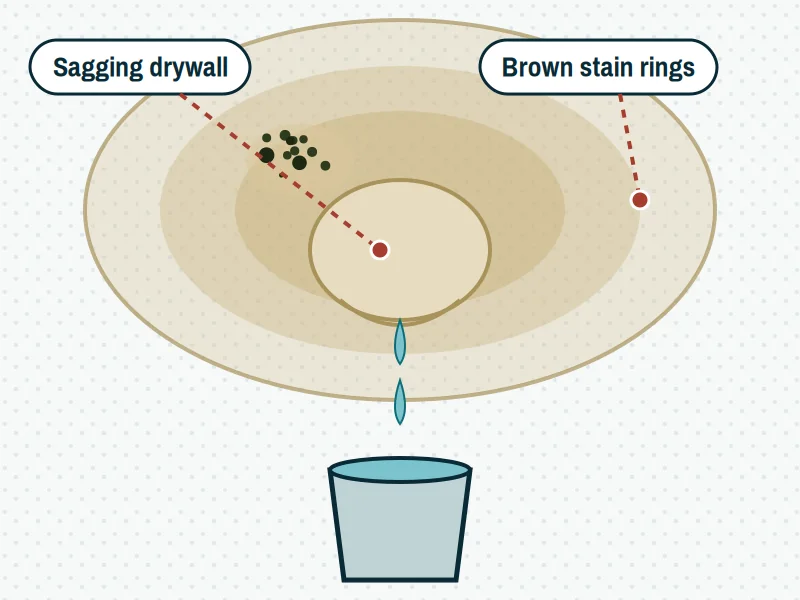
What water damage looks like on a ceiling
- Brown or tan rings that grow outward, often with a darker edge
- Paint that bubbles, peels or turns powdery
- A soft, bowed or sagging section
- Drips, or a damp patch that reappears after rain
- Dark spots inside the ring, which is where mold usually starts
What to do in the first hour
- Stop the water if you can. Shut off the main or the fixture supply for a plumbing leak. For a roof leak, a roofer can tarp it.
- Keep everyone out from under a sagging ceiling. Saturated drywall and wet insulation are heavy.
- Do not poke the bulge. Puncturing it can drop a lot of water and material at once.
- Move belongings and turn off ceiling lights and fans. Water and electricity do not mix. If water is near fixtures, shut off that breaker.
- Photograph everything before anything is moved. Insurers ask for it.
- Call. We will tell you what to do while you wait.
How we handle it
- Find where the water came from. Roof, plumbing or air conditioning changes the repair plan.
- Map the wet area. Moisture readings show wet drywall and insulation past the visible stain.
- Contain and filter. Poly sheeting and a HEPA air scrubber protect the rest of the house.
- Remove what cannot be dried. Saturated drywall and insulation come out. Sound framing is cleaned.
- Dry the structure. Air movement and dehumidification bring the cavity back to normal readings.
- Repair. New insulation, drywall, texture and paint once the source is fixed. See ceiling mold repair.
Roof leaks versus plumbing leaks
| Roof leak | Plumbing leak | |
|---|---|---|
| Timing | Shows up after rain or storms | Constant or tied to water use |
| Location | Often feet from the roof entry point | Under a bath, kitchen or water heater |
| Water quality | Rainwater | Clean supply water or drain water |
| Who fixes the source | Roofer | Plumber |
Drain-line leaks carry contaminated water, which changes the cleanup. We tell you which category we find.
Insurance
Many Florida homeowners policies cover sudden water damage but limit mold. Call your insurer promptly, keep photos, and keep damaged materials until an adjuster has seen them if you can. We provide moisture readings and photos with the job file.
Frequently asked questions
How fast does mold grow after a ceiling leak?
It can begin within 24 to 48 hours in warm, humid conditions if the drywall and insulation stay wet.
Can a water-stained ceiling be dried instead of replaced?
Sometimes, if it was caught quickly and the water was clean. Drywall that sagged, stayed wet for days or shows mold is normally replaced.
Should I wait for the roof to be fixed first?
Stop the water first. Removing mold under an active leak wastes money, because it will return.
Is a brown ceiling stain always mold?
No. Stains show water moved through the ceiling. Mold may or may not be present, and a moisture reading and a look at the back side of the drywall settle it.