
Drywall Ceiling Mold Removal in Fort Pierce, FL
Mold that has grown into drywall usually cannot be cleaned out, because drywall's paper face is porous and feeds mold. The affected section is cut out inside a sealed, HEPA-filtered work zone, the framing and insulation behind it are cleaned and dried, and new drywall goes in. Small surface mold on hard, well-painted drywall can sometimes be cleaned without cutting.
Drywall is gypsum sandwiched between paper. The paper is organic and the gypsum holds water. When drywall stays wet for more than a day or two in Fort Pierce's humidity, mold grows on the paper and works its way in. Paint hides it for a while. Then a dark patch shows up, or the paint bubbles, or the room smells musty.
This page covers mold in ceiling drywall and the walls beside it, which is how most jobs arrive: the ceiling stain started at a wall line.
When drywall can be cleaned and when it has to come out
| Condition | Usual result |
|---|---|
| Light surface growth on firm, well-painted drywall, small area | Can often be cleaned with HEPA vacuuming and detergent wiping |
| Paint bubbling, peeling, or drywall that feels soft | Cut out. Moisture has gone through the paper |
| Brown or yellow water rings with mold on top | Cut out. The drywall has been wet, and the back side is usually worse |
| Mold on both faces of the drywall | Cut out and inspect framing and insulation |
| Drywall wet for more than 48 hours | Likely cut out. Drying in place rarely recovers it |
We confirm with a moisture meter and, where needed, a small inspection opening. Cutting is done past the visible edge, because mold on the back side and inside the paper usually extends farther than what you see.
Textured ceilings: knockdown, orange peel and popcorn
Most Fort Pierce ceilings have a texture, and matching it is part of the job.
- Knockdown and orange peel are the most common. They can be matched after the new drywall is taped and finished.
- Popcorn (acoustic) ceilings need an extra step. Popcorn texture applied before the 1980s can contain asbestos, so we do not disturb it until it has been tested by a qualified lab. If the ceiling tests positive, the removal method changes, and we tell you before any work starts.
- Smooth ceilings show every seam and paint variation, so the repair needs careful finishing and full-ceiling repainting in some cases.
How we remove mold from drywall
- Locate the moisture. We map wet and mold-affected areas with a moisture meter and look above the ceiling for the source.
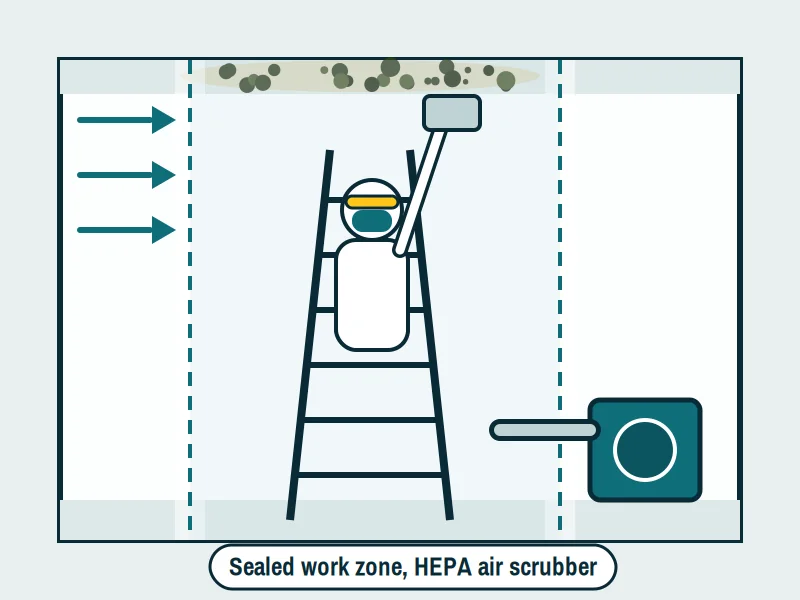
- Seal and filter. The work zone is sealed with poly sheeting, HVAC returns are covered, and a HEPA air scrubber runs throughout.
- Cut and bag. Affected drywall is cut out and bagged inside the containment. Nothing dry-scrapes or gets carried through the house.
- Clean the framing. Joists, studs and remaining surfaces are HEPA-vacuumed and damp-wiped. Wet or matted insulation is removed.
- Dry. The cavity is dried with airflow and dehumidification until moisture readings match the surrounding dry material.
- Hand off to repair. The opening is ready for new drywall, finishing and paint. See ceiling mold repair.
What we do not do
We do not spray a coating over mold and call it done. We do not scrub dry mold in an unsealed room. We do not paint over damp drywall. And we do not tell you the mold is "toxic" to sell a bigger job. If the affected area is small and cleaning is safe, we say so.
What drywall ceiling mold removal costs
Removal costs about $10 to $25 per square foot in public cost guides, and small jobs cost more per square foot because containment and setup are the same regardless of size. Rebuild costs, such as new drywall at roughly $1.50 to $3.50 per square foot and painting at roughly $1 to $3 per square foot, are separate line items. See the full cost breakdown.
Frequently asked questions
Can mold on drywall be cleaned instead of removed?
Sometimes, when it is light surface growth on firm, painted drywall. Once mold has grown into the paper face or the drywall has been soaked, cleaning is not reliable and the section should be replaced.
How far past the visible mold do you cut?
Usually 12 inches or more past the visible edge, or to the nearest framing, depending on moisture readings. Mold on the back side and in the paper extends beyond what is visible.
Can mold on drywall spread through the house?
Yes, if it is disturbed without containment. Scrubbing or tearing out moldy drywall in an open room releases spores into the air. That is why the work zone is sealed and filtered first.
Do you test popcorn ceilings for asbestos?
Popcorn texture from before the 1980s may contain asbestos. We do not disturb it until it has been sampled and tested by a qualified lab, and we explain the result and the options before any removal.
Will the ceiling match after repair?
The texture is matched as closely as possible. Smooth ceilings and older textures are the hardest, and sometimes the whole ceiling is repainted for a uniform look. Your scope says which.